Adele Marie Therias
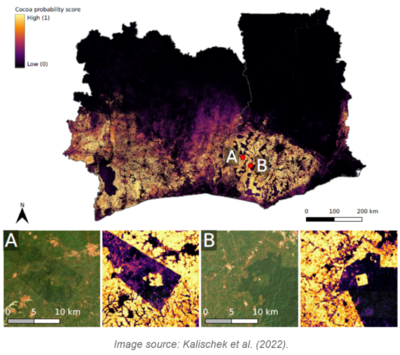
Ghana and Cote d'Ivoire are major producers and exporters of cocoa beans. In recent years, environmental and social factors have led smallholder farmers to encroach onto forest land. As of 2024, the European Union will ban the import of such products issued from deforested areas, a law whose enforcement will require highly accurate and timely tracking of farm extents. While the classification of multispectral satellite imagery is applied to detect other crops, cocoa presents unique challenges. First, West Africa has frequent cloud cover due to Monsoon climate, limiting the availability of cloud-free multispectral datasets and the temporal resolution of datasets. Second, agroforestry, which integrates shade trees to improve cocoa growing conditions, has a spectral signature and canopy structure similar to nearby forest. To address these challenges, researchers have implemented machine learning algorithms trained with radar, multispectral, or a combination of both, to identify cocoa crops. While most of these implementations use a pixel-wise classification that does not consider the spatial context, recent work has applied a Convolutional Neural Network trained with multispectral data that shows promising results in Ghana and Cote d'Ivoire. The objective of this thesis is to build on this research by integrating radar data into the network in order to test the impact of texture information on the accuracy of the deep learning classification.
Supervisors: Dr. Azarakhsh Rafiee and Dr. Stef Lhermitte